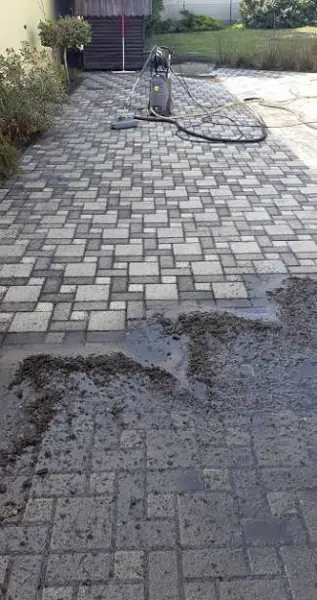
DIY pressure washer or professional cleaning: an honest comparison
A DIY pressure wash can work on a small, simple, sound surface with ordinary dirt. A professional clean makes more sense on larger areas, delicate materials, block paving joints, oil or rust stains, old paint, and anywhere wash water needs managing. The real difference is not the machine but knowing how each surface reacts.
Send us a photo and the m²When can DIY be a reasonable choice?
DIY can be reasonable when the area is small, the surface is hard and sound, the dirt is ordinary grime and there are no stains, joints or coatings to worry about. A short concrete path behind the house is a typical example.
Even then, the main risks are stripes from uneven passes and spray where you do not want it. We do not give step-by-step DIY instructions, but it helps to know that more pressure is not the same as a better clean.
It also helps to be honest about the time involved. Setting up, moving furniture, working evenly across the whole surface and clearing up afterwards usually takes longer than people expect, particularly on a first attempt and on a hot day.
Where does a professional clean make the biggest difference?
A professional clean makes the biggest difference on the surfaces and problems that do not forgive mistakes.
| Situation | Why it matters |
|---|---|
| Block paving | Joints are easily emptied by a jet aimed into them |
| Imprinted concrete | Sealer can be stripped unevenly |
| Natural stone | Soft stone scars with too much pressure |
| Oil and rust stains | Water alone does not remove them and may make them stand out |
| Old peeling paint | Flakes need collecting; bonded paint needs assessing |
| Large areas | Even results over big surfaces need a consistent method |
Our block paving cleaning service and oil stain removal page explain how those two cases are handled.
What usually goes wrong with DIY cleaning?
The common DIY problems are predictable: stripy results, joints emptied of sand, soft stone etched, oil stains looking darker against clean surroundings, and paint flakes or dirty water heading for the drain or the pool.
Most of these come from using the same setting for every surface and every mark. The article on what can go wrong with jet washing describes each one and the signs to watch for.
Is DIY practical if you live abroad?
If you live abroad, DIY is rarely practical. You would need to be on site, source equipment, clear the area and deal with the residues, often during a short visit you would rather spend differently.
A professional clean can be organised entirely by message: photos for the quote, access through your key holder, and before-and-after photos when it is done. Communication can be in English throughout.
Holiday rentals add another constraint: the clean has to fit between guest stays, and a half-finished DIY job left for the next visit is the worst outcome for the listing photos. Scheduling around the booking calendar is part of what we arrange.
Does DIY cleaning affect a later recolour?
It can. If you plan to recolour later, the preparation clean must be thorough and even, oil must be treated and loose material removed. A patchy DIY clean is not a substitute for that preparation, and damage such as etched lines or open joints has to be dealt with first.
In our renovations, the clean is done as the first stage, followed by crack repair, edge cut-in and two coats of synthetic resin paint. The patio and driveway cleaning service shows what that preparation includes.
How should you decide?
Ask yourself four questions: Is the area small and simple? Is the surface sound? Is it only dirt, with no stains or coatings? Will you be there to do it and deal with the water? If the answer to all four is yes, DIY may be fine.
If any answer is no, send us photos and we will tell you what a professional clean would involve. Orientative prices are on the partner page for pressure washing cost, and our article on what affects the cost of jet washing explains how quotes are built.
Frequently asked questions
Is a rented pressure washer the same as a professional one?
The machine is only part of it. What makes the difference is choosing the pressure, nozzle, distance and angle for each surface, testing first, treating stains properly and managing water and residues. Experience with each material is what prevents damage.
Can I clean my block paving myself?
You can, but block paving is one of the easiest surfaces to damage, because a jet aimed into the joints empties them. We do not give DIY instructions; the joints are a good reason to hire someone. Joints that have been emptied take time and effort to restore.
Why did my oil stain get darker after I washed it?
It probably did not get darker; the area around it got cleaner, so the contrast increased. Water alone does not remove absorbed oil. A targeted treatment is needed. Treated properly, many oil stains still lighten considerably even after a DIY attempt. Send us a close-up and we will tell you what to expect.
Is DIY cheaper?
In direct cost, often yes for small areas. The hidden costs are your time, equipment hire, the risk of damage and the effort of dealing with residues. On larger or delicate surfaces, those can outweigh the saving. Doing it once badly can cost more than doing it once well.
Can you fix a DIY clean that went wrong?
Often we can even out stripes with a consistent re-clean, and open joints can be refilled. Etched stone or scoured concrete cannot be reversed by cleaning, though a recolour can even out concrete. Photos of the damage help us tell you what is possible.
Do you sell or recommend pressure washers?
No. We do not sell equipment and we do not recommend brands or products. Our service is the cleaning and preparation work itself. We focus on doing the work well rather than on selling anything. If you want to buy equipment, a specialist retailer can advise you. Our role is to give you an honest view of your surface.
Is it safe to pressure wash near the pool myself?
Wash water and debris should be kept out of the pool, and wet surfaces around it can be slippery. If you clean yourself, plan where the water goes before starting. Also keep children and pets away from wet surfaces until dry. Telling your pool maintenance company in advance is a sensible precaution.
Can I just clean before you recolour?
We do the preparation clean ourselves as part of a renovation, because every later stage depends on it. A DIY clean beforehand does not replace that step. Clearing the area of furniture and vehicles is the most useful preparation you can do. Everything else is part of our preparation stage and is included in the work.
What about cleaning products from the shop?
We do not recommend products by name. Some products can affect coloured surfaces, stone, plants or pool water, and residues should not be washed into drains. Tell us if anything has already been applied, because residues can affect how the surface reacts to cleaning or coating.
When should I call a professional straight away?
When there is oil, rust or old peeling paint, when the surface is block paving, imprinted concrete or soft stone, when the area is large, or when you are not on site. In those cases the risk of an uneven or damaged result is highest.